
The agency had received Rs 946.51 crore to manage its affairs in the Budget Estimates for 2023-24, which was later increased to Rs 968.86 crore in the Revised Estimates.

Ducati would like to develop a motorbike racetrack on the lines of the Buddh International Circuit.
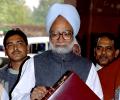
'We are going to need more technical people in government.' 'You can't expect a generalist to understand the complicated world of financial engineering.' 'I regret to say that most of our politicians have no competence to deal with these things. Nor is there a willingness to learn.'
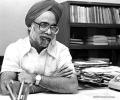
What stood out in his 15-year journey as a member of the political executive at the Centre was his glowing record as India's most successful and effective finance minister. Both as prime minister and finance minister, he understood the importance of gradualism, except when the economy or the polity was in a crisis.

Helicopters are anticipated to be more in demand compared to fixed-wing aircraft as choppers will help in providing accessibility to rural and remote areas in a shorter time.
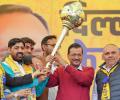
The BJP may win more seats in the February 5 assembly election, but not enough to trump AAP, notes Ramesh Menon.
Delhi faces a severe financial crunch and the deficit is largely due to numerous welfare schemes without adequate revenue flowing in. The success of welfare schemes and electoral promises will need careful financial planning and out of the box thinking to whip up additional revenue, notes Ramesh Menon.
Lavasa will replace Rajan Watal, who retires on Saturday, even as the budgetary process is yet to be finally completed.

'If such a practice were feasible, every state would seek additional funds, posing a significant risk to the overall health of the economy.'

According to an Andhra government statement, Naidu 'reposed confidence' in the PM's leadership.

The Reserve Bank of India (RBI) booked massive gains on its foreign currency sales and needed to provide much lesser for its reserves in 2020-21 (FY21), helping it to carve out a significant Rs 99,122-crore dividend for the government, revealed the RBI's annual report for FY21. By doing so, the central bank's risk buffers have reduced to the bare minimum, which may restrict some of RBI's scale of operations, and would likely hamper dividend payout for financial year 2021-22, said analysts. The annual accounts are for nine months ended March 31, 2021 since the RBI changed its accounting year from July-June to April-March from FY21.

Prabhu hoped that during this 3-4 years period, railways would be able to absorb the impact from their resources

Amid a debate on the freebies, the Election Commission on Tuesday proposed amending the model code to ask political parties to provide authentic information to voters on the financial viability of their poll promises.

For the company's latest energy initiative to expand its green energy and storage portfolio, some analysts are beginning to suggest a closer look at some of its segments. In his address to shareholders in the company's FY22 annual report, billionaire Mukesh Ambani, chairman and managing director of the company, said: "The green energy value holds great promise to outshine all our existing growth engines in just 5-7 years." The company has marked an investment of Rs 75,000 crore towards its new energy plans, which include solar energy value chain, green hydrogen, energy storage and other similar businesses.

FinCom prescribes scrapping of effective revenue deficit.
Adani group opened a $1.2 billion copper plant, bought a port in Odisha, raised stakes in a cement company and stitched an alliance with rival Mukesh Ambani's Reliance Industries, all in a matter of one week in signs that the apples-to-airport conglomerate has shrugged off the Hindenburg effect and is back to rapid expansion spree. In the last one week, Adani group has through regulatory filings and press statements announced expansions and investments in its mainstay ports business, diversification into metal refining, fund infusion into a two-year-old cement foray and continuing progress in the commissioning of its mega solar project.

'Isn't it obvious? Do you have a doubt? There is so much data that shows that there is quid pro quo.' 'There are many instances of donations being given after the raids, donations being given before the award of a contract and many other permutations and combinations.'

Being mandatory, these recommendations will have to be immediately built into the Budget for 2015-16.
Besides advancing the presentation of the Budget to perhaps the first week of January, , there are four new initiatives that could be rolled out from the next Budget, says A K Bhattacharya.

The obvious temptation for Mr Jaitley would be to achieve a better fiscal deficit figure than what he had promised in July.

The finance minister defended the change in the tax rates.

Grasim Industries has announced a rights issue of around Rs 4,000 crore with the promoters committed to fully subscribing to their entitlements and to covering any unsubscribed portion. This is to part-fund capital expenditure (capex) of Rs 10,000 crore in a new foray into the paints business. The company has already invested Rs 3,640 crore in the paints business (by Q1FY24). The management has outlined a capex of Rs 5,700 crore for FY24, which includes Rs 4,280 crore allocated for the paints business, of which Rs 1,050 crore has already been spent in Q1FY24.
Pradhan Mantri Jan Dhan Yojana and Make in India -- are not covered here.

There are several welcome standalone reforms, but these do not add up to a coherent strategy to achieve a $5 trillion economy or secure Aatmanirbharta, observes Rathin Roy.

Most expect the Budget to be path-breaking.

By any economic theory or doctrine, this is no Budget that supports economic recovery, whether through supporting aggregate demand, or through expansionary stimulus, declares Rathin Roy.

Budget for 2022-2023 has returned to its agenda for protectionism in the name of creating a self-reliant India, points out A K Bhattacharya.

There are some 20-odd schemes with this default provision, or something close to it.

The Economic Survey states that the rationalisation and reprioritisation of subsidies through better targeting would play a vital role in fiscal consolidation and in targeting expenditure more towards inclusive development.
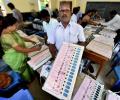
Will the EC would make an example of the RK Nagar by-election, either by ensuring free and fair polls or by countermanding the same, asks N Sathiya Moorthy.
The problems facing India and its economy are far too severe and deep to be fixed in 100 days, and an excessive focus on the first 100 days might have indicated that the government had failed to understand that.

Government looking at cushioning slowdown due to demonetisation with sops and higher outlay for micro, small and medium enterprises, agriculture, and affordable housing.
The RBI expects change, presumably commencing in the next Budget, but must hold its current view until this actually happens.

Will the new Congress government implement the five 'guarantees' that helped it in part to wrest power from the Bharatiya Janata Party in toto or will they now add a "conditions apply" clause?

Days after cutting the salaries and other allowances of MPs and ministers, the government has passed instructions to all departments to reduce their expenditure by as much as 60 per cent from their first-quarter spending plans.

The NHRC said that it has received several complaints regarding the ongoing farmers' protest.
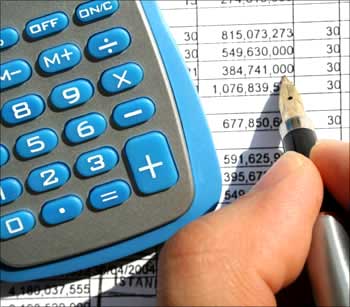
Credibility of fiscal promises is a virtue that no finance minister can afford to lose.
The new Companies Bill will boost such spending by both public and private companies. Praful Patel, Union minister for heavy industries & public enterprises, speaks to Business Standard on the issue.
The finance minister said the economy had been slowing.

Ahead of the general elections, a slew of states and also the Centre had doled out sops to the marginalised sections, including the farmers and the poor.
